You're at the playground and your child falls off the swing.
You're driving down the street and you hit a bicyclist.
You're walking through the mall and you see somebody lying on the floor.
What do you do? If you're like most people I know, you ask the person "Are you all right?"
Please don't. Nobody wants to tell you that no, they're not all right. They might not be all right, but it's often not until a few hours or even days later that the pain becomes too much, and a visit to the emergency room reveals something wrong. I have had the experience of falling or otherwise having accidents, and people have immediately asked me if I was all right. They didn't take me to the hospital and wait for the results of the x-rays. They didn't check for welts and bruises to develop, or even wait to see if there was any blood. When they ask you, "Are you all right?" they're not really asking you to give them a report on the extent of your injuries, but they're asking for permission to walk away and forget about you. If you tell them you're all right, you let them off the hook. They may later argue that you absolved them of all responsibility when you told them, five seconds after your accident, that there's nothing wrong with you. If you continue to experience pain and later turn out to have a broken bone or chipped tooth, they will resent you for changing your mind about the accident. Perhaps they'll even think you're lying and making up a new problem that wasn't there immediately after the accident.
This is all especially true with children. They may be unwilling to tell you they're not all right, because they feel like they've failed or been a loser or given the "wrong" answer.
The best thing to ask somebody who has had an accident is "Are you hurt?" Doing so trains the child to take time and think systematically about how everything feels, and it trains you to be more compassionate toward others. It also gives the child or injured party permission to be honest.
Sunday, September 11, 2011

Saturday, September 10, 2011
9-11, Ten Years After

I remember what I did that morning. I had taken the children to school, and I had to drop some old clothes off at the thrift shop, and then I had plans to see my lawyer to deal with some paperwork. My husband had died two weeks earlier, and I wanted to donate some of his things to charity. They had played a story at around 6:20 on NPR's Morning Edition about new teachers, and I had missed part of it. I knew they would rebroadcast the program and repeat that particular story at 8:20. I was in the thrift shop parking lot waiting for them to open, expecting to hear the voice of Claudio Sanchez, NPR's education reporter. Instead, NPR interrupted its regularly scheduled program to bring us the horrendous news. Having gathered my family around my husband's bedside and said good-bye to him, I couldn't help thinking of the families whose loved ones were taken from them that morning without warning, without getting their affairs in order, without any opportunity to make peace with each other.
We might focus on what The September Eleventh Attacks mean for parents with young children. I would argue that although we might expect nightmares and emotional trauma in our current teenagers and young adults, today's toddlers have been spared all that, and we should keep things that way. For those of us old enough to remember where we were on September 11, 2001, November 22, 1963, or December 7, 1941, these events were the defining event of a generation. But for today's primary school children, 2001 is history as ancient as or March 25, 1911 or April 12, 1861 or October 14, 1066. We can't expect very small children to ever feel the loss of those we remember before 2001, not on a personal or a national level, nor to feel the connection many of us feel with others who also lost people we loved. Let us not fault them if they can't get excited about all the memorial services and speeches, the flag-waving, and the rhetoric, and let us not use these children as an excuse to whip up hatred against people in other countries, nor blame them for being insufficiently patriotic on account of the World Trade Center's destruction.
How many of us ever consider the plight of the English during WWII? During the Battle of Britain, or the "Blitz" as many called it, German bombers flew over London every night. Large swaths of that city were destroyed, and if you walk down the streets there today admiring the beautiful eighteenth century buildings, you'll see the random post-WWII building that doesn't fit into the cityscape. London's urban renewal projects owe a great deal to the Luftwaffe. We should consider the terror the English people felt in 1940 and the fear and uncertainty they must have suffered over the outcome of that war. Some families sent their children off to live with strangers in the country, not sure they'd ever see them again. Some spent many a night packed together and trying to sleep in the Underground stations, just hoping that when the noise above them and the all clear sounded, their houses would not be reduced to rubble.
When I got to my lawyer's office that fateful morning in 2001, he was watching the television coverage from the World Trade Center, and he said, "Now Americans know how Israelis feel." We may expect terrible things to happen in other countries, but I believe the sheer novelty of such an attack on the United States of all countries was as much a part of people's outrage as the death and destruction themselves. Yet since 2001, nothing similar has happened again.
For some reason, Americans have developed an astonishing willingness to milk a ten-year-old tragedy for all it's worth. Somehow, I doubt that they marked December 7, 1951 with all the somber commemorations we're seeing now. I would like our country to move past 2001. What many Americans don't realize is that people around the world and even around this country face tragedy all the time. We don't pay attention to the wars and conflicts being fought in Congo, Mexico, Sudan, Yemen, or to the drought and famine in Ethiopia. The storms, floods, and earthquakes of a few years back may not make headline news anymore, but people are still suffering. Even the small-scale tragedies that affect some families in our own cities, the grinding poverty, hunger, and homelessness, and the drive-by shootings escape our notice. What makes September 11, 2001 special is that it was a day when the nation suffered an organized attack from outsiders, something we haven't experienced as a nation since the early 1800's. Since 1814, we have made a point of fighting all our wars on somebody else's soil.
When I got to my lawyer's office that fateful morning in 2001, he was watching the television coverage from the World Trade Center, and he said, "Now Americans know how Israelis feel." We may expect terrible things to happen in other countries, but I believe the sheer novelty of such an attack on the United States of all countries was as much a part of people's outrage as the death and destruction themselves. Yet since 2001, nothing similar has happened again.
For some reason, Americans have developed an astonishing willingness to milk a ten-year-old tragedy for all it's worth. Somehow, I doubt that they marked December 7, 1951 with all the somber commemorations we're seeing now. I would like our country to move past 2001. What many Americans don't realize is that people around the world and even around this country face tragedy all the time. We don't pay attention to the wars and conflicts being fought in Congo, Mexico, Sudan, Yemen, or to the drought and famine in Ethiopia. The storms, floods, and earthquakes of a few years back may not make headline news anymore, but people are still suffering. Even the small-scale tragedies that affect some families in our own cities, the grinding poverty, hunger, and homelessness, and the drive-by shootings escape our notice. What makes September 11, 2001 special is that it was a day when the nation suffered an organized attack from outsiders, something we haven't experienced as a nation since the early 1800's. Since 1814, we have made a point of fighting all our wars on somebody else's soil.
Perhaps it's time for those making all this fuss to grow up.
Friday, September 9, 2011
Let's go to the grocery store!
Do you dread shopping with your toddler? I remember once having an accident in that A & P where my mother used to take me. I was having a bit too much fun scooting around with the grocery cart, and I fell and got a bloody lip. I still have the scar, so when I see children standing up in grocery carts, I always want to say something to the parents.
Taking a two-year-old to the store can be a series of disasters, especially if you just expect the child to sit quietly in the cart and not embarrass you in public. It can also be a tremendously educational and entertainment experience, if you plan it well, but it takes more than just a shopping list. A little creativity can go a long way. So does a little talk before you leave the house about what kind of behavior is appropriate or inappropriate in public and what rewards a child can earn by behaving appropriately. Maybe you have one of those "rewards card" things the supermarkets give out to encourage customer loyalty. You could create a rewards card to keep track of for your child's good behavior. As for customer loyalty, though, I would suggest mixing it up and shopping at different stores sometimes. That way your child can learn about choices and competition and get a better understanding of the community in which you live.
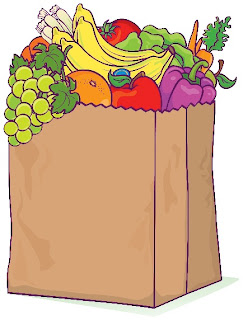
It helps to plan ahead, decide what you're going to serve for dinner for the week, and shop accordingly. If you can plan the week's meals around foods that are on sale, you can save some money. Walking into the store with a list lets you save time, and it lets you show your child how business-like and in charge you can be. Let your child have some input in creating the shopping list. As I've said before, you can negotiate over the questionable items. That way, you can not only help your child develop problem-solving skills, but also get some behavioral concessions out of your child. Don't be afraid to say, "Cookies aren't very good for us. How about some fruit instead? Or a trip to the library?"
Try to schedule your trip to the store after a nap and meal so the child isn't too cranky, and take along some emergency supplies, like snack food in your own container or a small toy on a tether. As for feeding your child food from the store before paying for it, yes grapes and snap peas are healthier than m&m's, but remember you're setting an example, right? A very small child won't understand the difference between unit pricing and bulk pricing. It's a good idea to avoid shopping on an empty stomach, because then you'll be less likely to waste time and buy junk you don't need on impulse.
Of course everybody needs to eat. Once you're in the store, you can use your need for food to strengthen all kinds of educational skills and teach all kinds of lessons,depending on the age of the child, from reading readiness to vocabulary, colors, shapes, math, money, economics, geography, health, nutrition, self-discipline, social skills, and decision making. Depending on the age of the children, you can assign them "jobs" like finding the apples or letting you know whether the flat green vegetable you're looking at is a carrot or not. You can compare prices between brands. If you take a little world map along, you can note where the bananas, blueberries, kiwi fruit, and all the other foods come from.
When my children were very young, my husband and I used to go shopping in the evening and make it a family affair. We would take turns, one of us pushing the cart with the baby in it, while the other one took our toddler on a walk through the aisles. I decided a three-year-old would do less damage in the toilet paper and fabric softener aisles than in the spaghetti sauce and pickle aisles. We made a game of counting all the babies and teddy bears we saw on all the product packaging. It got us out of the house, it kept the kid busy, and it helped her get some math practice. Furthermore, it was a way to avoid arguments ("What do you mean, you forgot to get dish detergent?" "You didn't tell me what kind of lettuce you wanted!", etc.) or paying a babysitter, or spending an evening as couch potatoes.

It helps to plan ahead, decide what you're going to serve for dinner for the week, and shop accordingly. If you can plan the week's meals around foods that are on sale, you can save some money. Walking into the store with a list lets you save time, and it lets you show your child how business-like and in charge you can be. Let your child have some input in creating the shopping list. As I've said before, you can negotiate over the questionable items. That way, you can not only help your child develop problem-solving skills, but also get some behavioral concessions out of your child. Don't be afraid to say, "Cookies aren't very good for us. How about some fruit instead? Or a trip to the library?"
Try to schedule your trip to the store after a nap and meal so the child isn't too cranky, and take along some emergency supplies, like snack food in your own container or a small toy on a tether. As for feeding your child food from the store before paying for it, yes grapes and snap peas are healthier than m&m's, but remember you're setting an example, right? A very small child won't understand the difference between unit pricing and bulk pricing. It's a good idea to avoid shopping on an empty stomach, because then you'll be less likely to waste time and buy junk you don't need on impulse.
If you have another adult, or another child old enough to walk around the store without supervision, you can even make it a family game night and organize teams for a scavenger hunt.
- Let's see if we can find something in a big blue box that has the first letter of your name on it.
- Now let's look for something we want to eat for breakfast, and it's shaped like circles.
- Next, we need something in a round box, and it has a picture of a man in a big hat on it.
- How about something good to drink that doesn't have high fructose corn syrup in it?
- And when we've got everything on our list, we'll meet Mommy by the orange juice.
Thursday, September 8, 2011
You can't always get what you want, part 3: But if you try sometimes, you just might get ahead of people who don't.
 According to a landmark study based on data collected at Perry Nursery School in Ypsilanti, Michigan back in the 1960's, children who received just a few hours of preschool education a week outperform those who didn't. The Perry study led to the creation of the federal Head Start program.
Subscribe to:
Posts (Atom)