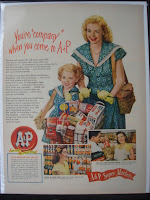
 One of my most vivid childhood memories was of going to the A & P with my mother and wanting one of the big boxed dolls they displayed on the top shelf above the food in aisle 8. I don't remember whether I whined and acted up and gave my mother grief, but of course these beautiful dolls were way too expensive for my parents to buy, so I never got one. I did get one doll I loved and played with for years, and I did learn to forgive my parents for not getting me a big beautiful doll from the A & P. As disappointing as my childhood was, I knew I had it better than the millions of children around the world who went to bed hungry every night or whose lives were ravaged by war, disease, and oppressive political regimes. Yet I have seen plenty of small children over the years carrying on in the grocery store whining and begging for toys and special treats, and I began to dread those trips to the supermarket that I would have when I had my own children.
Here are some of the possible responses to a child who pulls a big loud embarrassing I WANT IT! tantrum in the store:
- "No you don't, so shut up!"
- "No you don't, so shut up! [SLAP!]"
- "Yes, of course you do, and Mommy loves you, so she's going to give it to you--Yes she is!--because nothing is too good for Mommy's wittle pwecious! Dis world just wevolves awound Mommy's wittle pwecious--Yes it does!"
- "I understand you want it, but if I refuse to spoil you by giving in to all your demands."
Which answer do I recommend? None of the above.
If you don't give in to a child's demands, it's best to give your child a good reason. There are some very good reasons to say no:
- We can't afford it.
- We don't have space for it in our house.
- I don't approve of it, because it's stupid or against our religion, or harmful for you, or of bad quality, or manufactured under unfair conditions by a company I'm boycotting on moral grounds.
- Your grandmother and I already have secret plans to surprise you with one on your birthday. (But you probably can't tell your child that.)
And there are bad reasons:
- I don't believe you're good enough to deserve it.
- This is going to be one power struggle I insist on winning, so there!
Sometimes it's useful to go beyond the "Because I'm the Mom, and I say so" argument. Doing so helps a child develop thinking skills and respect for the intelligence of both of you. Additionally, sometimes it's useful to understand why the child is asking for something. It could be: - because the child truly wants the toy
- because the child wants your attention
- because the child wants you to recognize and respect his or her feelings.
In other words, getting the toy might not be the real issue. Your child might be satisfied with - "I know you want that. It does look like fun, doesn't it? And I'm sorry, but I can't get it for you today."
That approach can work with a lot of other things in life, too:
- "I know you don't enjoy buckling into your car seat, but you don't have a choice about it."
- "I know it's cold out here. The weather is one of those things we can't do much about. Fortunately, the bus will be here soon, and it will be warmer."
- "I know you wish it wasn't necessary to get your tetanus shot, and it makes me sad to see you stuck with needles, too, but it's the only way we can protect you from a disease that's even worse, and it will be over quickly."
- "I know you loved that book, but the library needs it back today so somebody else can have a turn to read it. Let's try to check it out again soon, all right? Or should we buy our own copy?"
As for treats and toys from the store, you can avoid or reduce the likelihood of conflict if you plan your shopping trip in advance and find a way to negotiate with your child. It's called being proactive. We'll focus more closely on grocery shopping soon. To keep it simple for now, discuss expected behavior in advance and work out a deal. You want your child to avoid embarrassing you in front of strangers, and you can use a simple reward system to keep the child in line. It's more effective than punishment. Perhaps if a child follows the behavior rules you spelled out, like
- stay seated in the cart,
- keep hands off merchandise,
- use your "inside" voice in the store, and only polite, pleasing tones
through the entire shopping trip, (remember, don't stand up, don't grab, don't talk, don't whine will not work as well) then you can let the child have a small treat (under $1) as a reward for good behavior when you go shopping, and hopefully it will be a healthy one. If, like me, you serve a sugary dessert only once a week, then your children won't imagine they're entitled to candy every day, and you can try using cake or cookies as a special reward to encourage the behavior you want from them. Or you can give them a reward that's not some material (nor fattening) thing.
If it's something larger and more expensive that your child really wants, you may be able to work out a long term plan. Perhaps you had thought about getting something in that basic price range for Christmas, but you hadn't found the perfect gift yet. You can tell an older child (probably not a two or three-year old) that instead of twenty $1 treats, he or she can collect some kind of "good behavior" points for twenty weeks and earn a $20 prize. It might not be a surprise, but a child will feel more satisfied with a gift that's earned and not arbitrarily bestowed from out of the blue. Children need to learn delayed gratification some day, so you may as well work on that now. I haven't actually seen big toys in supermarkets since I was a girl, but if your child wants some kind of special treat advertised elsewhere, you can still use shopping behavior as part of your plan.

And remember that the best things in life aren't things. Sometimes a hug, a smile, an "I love you" or "I was very proud of you today" or some lap time with a good book is worth a hundred little shiny trinkets or a thousand candies.


