My friends are sharing this picture on facebook today, and I think it says something pertinent to Father's Day, in memory of my husband.
Anyone who has a man like this in her life, let him know you appreciate him, and celebrate!
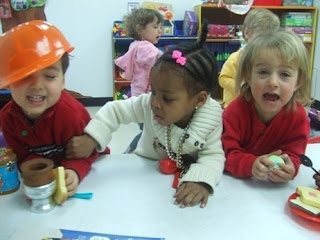 According to a landmark study based on data collected at Perry Nursery School in Ypsilanti, Michigan back in the 1960's, children who received just a few hours of preschool education a week outperform those who didn't. The Perry study led to the creation of the federal Head Start program.
I heard a pair of very interesting stories about preschool on National Public Radio last week. The first one, although it said nothing I didn't already know, spoke to me personally, because I attended Perry for two years. It seems now that the preschool advantage remains with children not only through high school, but into adulthood. More about that another time. I recommend that people click on the link and listen to the story.
However, what I found particularly novel and interesting was something one school administrator said in the other story. It seems that because many New York parents want their children to have all the advantages, competition for expensive (would you believe $30,000?) high-status preschools is fierce. The preschool interview is now as stressful as a job interview, and several of the experts featured in the story offered advice on how to ace this interview. For example, if a child visiting a preschool sees a toy truck on a shelf across the room, what should the best child for that school do?
The answer surprised me. I grew up, as did many people I know who don't make lots of money, with parents who subscribed to the "No, you can't do that" school of parenting. I would think a polite well-behaved child would admire the truck from afar, but not go all "gimme, gimme, I WANT it!" and grab at it. Perhaps that is why I'm not pulling in a six figure income. It seems the "correct" response to an appealing toy that this school wants to see in an applicant is, in fact, some variation on the "gimme, gimme, I WANT it!" response.
After all, preschools have toys so that the children there can play with them. A normal healthy toddler should have the curiosity to investigate new toys. A child who is too shy to express an interest in the toys available at preschool might grow up to become an adult too shy to stand up for her (or maybe his, but face it; it's usually her) rights. A child can certainly toddle across a room and touch a toy, especially ask for permission to play with it, without doing violence to others or trampling on their rights. Do we want our children to go through life believing, "They'll never let me do that"? Or, "I can't do that"? or "That's too challenging for me to succeed"? Or worse yet, "Only other people can have that, but I'm not good enough to deserve it"?
By all means, we should teach our children to respect other people, but we must not forget to teach them self-respect. Let us not be afraid to raise self-confident children who have the courage to express their feelings, who believe in and can stand up for themselves.
What is my biggest parenting Pet Peeve? Parents -- or teachers -- telling children they are bad.
Once I saw a toddler visiting her grandmother, who told her, when she climbed onto a chair, that she was a "good" girl. I cringed. It seemed that according to this grandmother, a child's moral worth is a function of her ability to climb onto a chair. Then the little girl tried climbing onto the table, and suddenly she was pronounced a "bad" girl. Does that mean children who can climb are good, but children who climb are bad? That made no sense to me, and I told the old woman as much in no uncertain terms.
If Timmy dunks Mary O'Shaunessy's braid in his inkwell, should we tell Timmy that he's bad, a terrible person? No, we should tell him he did the wrong thing. We can ask him how he would feel in Mary's place. We should make him understand how it hurts or offends people when we put ink in their hair or how it violates their dignity, which we ought to respect. We can demand that he apologize to Mary and make some appropriate restitution. But if we pass judgement on him, then he may begin to believe he is existentially evil and grow up loathing himself. Or he may imagine he must persist in his bad behavior, because he knows that's what the world expects of him.
We may disagree on religious grounds, but whatever one may believe about human nature and sin, one can do serious psychological damage to a child by confusing that child's specific behavior with the child's innate value. We can hate the sin, but we must still love the sinner, especially if we are the sinner's parents.

 According to a landmark study based on data collected at Perry Nursery School in Ypsilanti, Michigan back in the 1960's, children who received just a few hours of preschool education a week outperform those who didn't. The Perry study led to the creation of the federal Head Start program.
